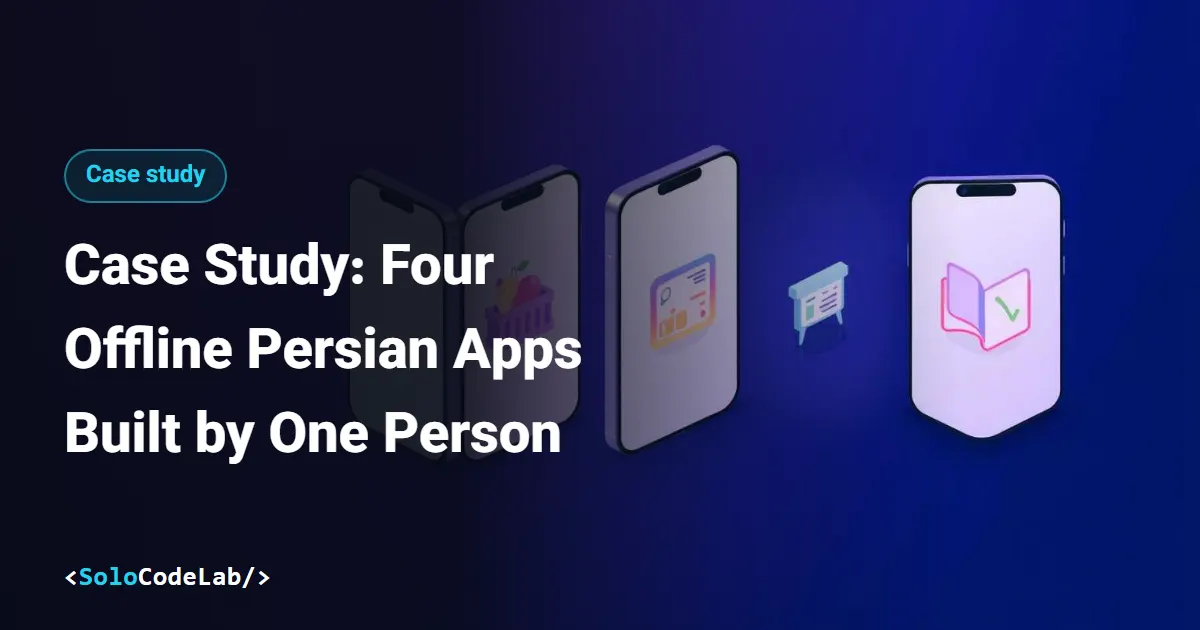
The best proof of app-building ability is apps that actually exist. Here are four of our own products and why each decision was made, so you can see what commissioning a mobile app with us looks like. We don’t quote user or sales numbers because we don’t want to make unproven claims.
- AzmoonYar Honarestan
- Practice questions for each module
- Explained answers and a report card
- Chekyar
- Record cheques with Jalali dates
- A reminder before the due date
- KiloChand
- Record invoices and spread the fare
- A suggested price per kilo (in testing)
- VakilYar
- Mahr, inheritance and blood money
- Persian PDF reports
Four apps, four problems
| App | Problem | Solution |
|---|---|---|
| AzmoonYar Honarestan | Vocational students lack focused practice for each module | 1,663 multiple-choice questions from 7 textbooks across 35 modules, with explained answers, timed tests and a report card |
| Chekyar | Tracking received and issued cheques and due dates is scattered | Record cheques with Jalali dates and photos of both sides, due-date alerts, PIN and fingerprint lock |
| KiloChand | Wholesale fruit buyers don’t know their real profit | Record stall invoices with grade and unit, spread van fare, suggested price per kilo (in field testing) |
| VakilYar | Mahr, inheritance and blood-money calculations are manual and error-prone | Offline calculators citing the legal article, with Persian PDF reports |
Which decisions were shared by all four?
- Offline first: no internet needed and no user data sent, which is both faster and more trustworthy for Iranian users.
- Truly Persian: Jalali dates, Persian digits, right-to-left layout and Persian PDFs were in the design from the start, not added at the end.
- Simple selling without a complex gateway: activation by code, so version one ships quickly and in-app payment can be added later if needed.
- A free part of every app: users try it before they buy.
Lessons for commissioning your app
- Start with one clear problem; each app above does one thing well.
- If user data is sensitive, being offline is an advantage; the cost and timeline of the app also drop when you remove the server.
- For the Iranian market, plan distribution and payment from day one.
- A small, complete first version beats a large, unfinished one; user feedback decides version two.
You can see the same product thinking in starting with AI in an Iranian business: begin with one small, measurable task.
A newer example: Hazeri, offline face-recognition attendance.
The newest example is building a free Iran travel app with AI, with data fact-checking and tap-by-tap testing on a real phone.
Frequently asked questions
Who built these apps?
Saman Ghahreman, AI researcher and AI model developer and founder of SoloCodeLab, designed and built all of them alone.
Can I download and try them?
AzmoonYar and Chekyar have free versions; KiloChand and VakilYar are in testing. Details are on each product page.
Why are the apps offline?
For speed, trust and user privacy; no data is sent to a server and they work without internet.
Can the same approach work for my app?
It depends. If your app needs accounts or shared data, a server is required; the order checklist shows what to clarify.