Giyahbin — plant safety guide
A free offline guide to toxic and safe plants of Iran, for travellers and hikers
- Offline list of 125 plants
- Guided identification in three taps
- 31-province filter
- Look-alike warnings
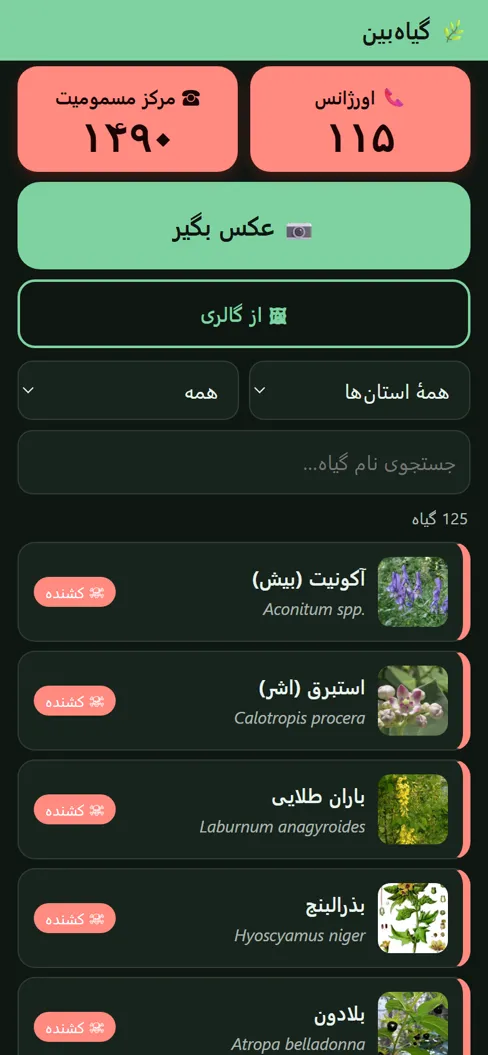
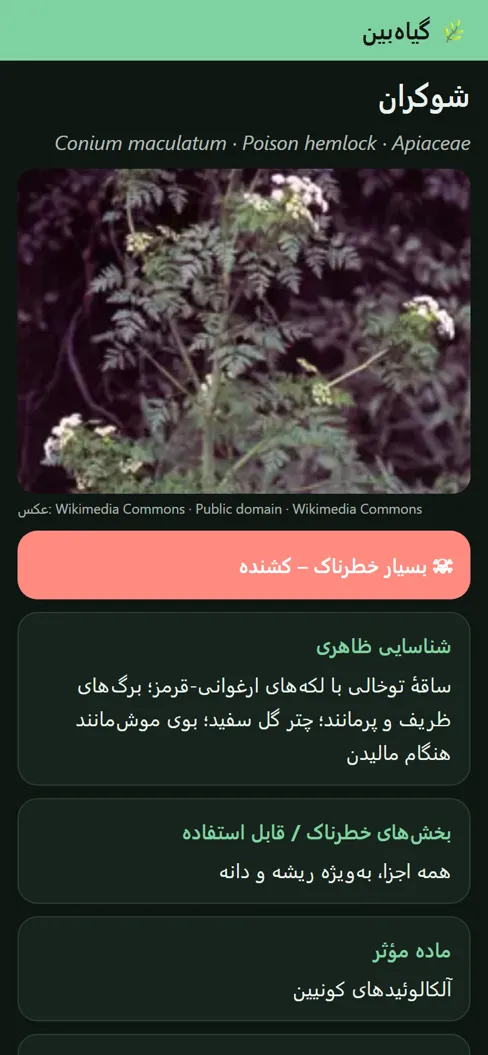
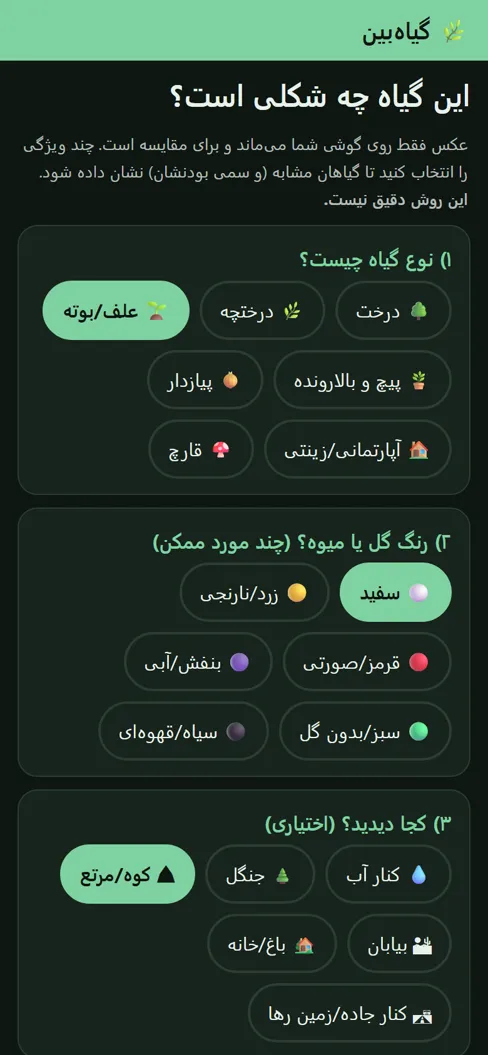
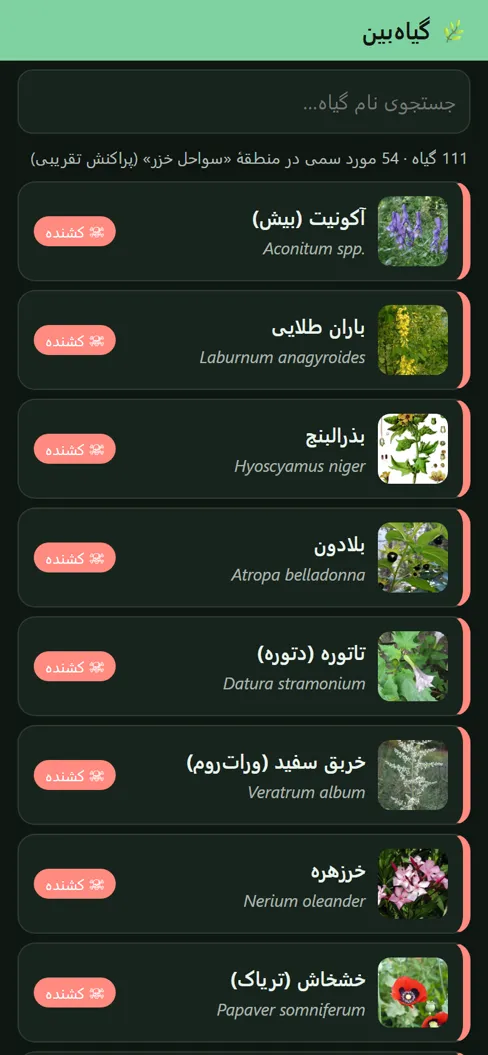
Giyahbin is a free offline Android app that shows 125 toxic and safe plants of Iran with photos, poisoning symptoms and first-aid notes. A traveller picks three simple traits and sees similar plants. Results are estimates, not expert advice; never eat any wild plant or mushroom based on this app alone.
Why Giyahbin?
Made for: travellers, backpackers, hikers and families with young children
Offline list of 125 plants
Each plant is labelled deadly, toxic, low-risk or harmless, with the active compound, symptoms, dangerous parts and look-alike plants.
Guided identification in three taps
Pick the plant type, flower or fruit colour and habitat to see similar plants and whether they are toxic. This is an estimate, not a definitive identification.
31-province filter
See which toxic plants are common in your region. The distribution is regional and approximate, not official per-province statistics.
Look-alike warnings
For example, poison hemlock resembles parsley and meadow saffron resembles wild garlic. The app flags these dangerous resemblances next to each plant.
One-tap emergency calls
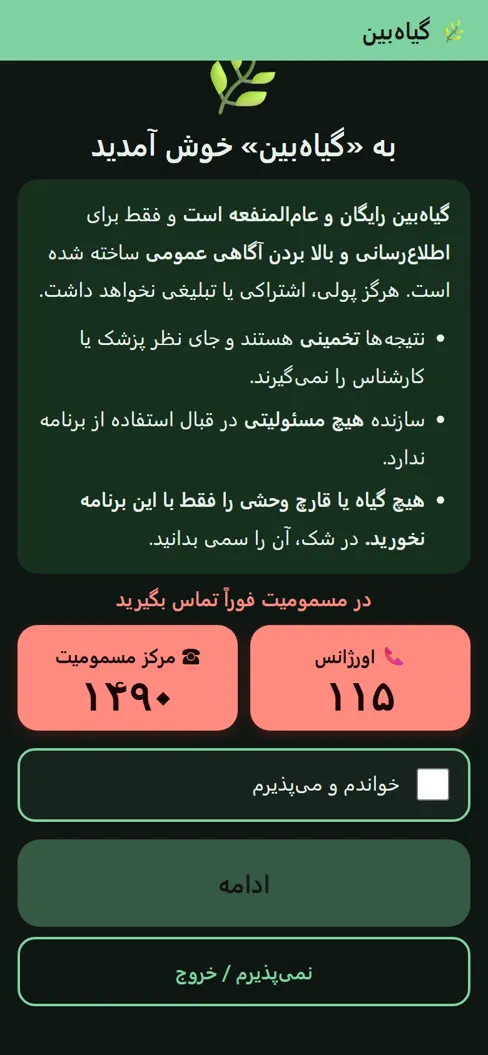
Large 115 and 1490 buttons sit on the key screens and only open the phone dialler; you place the call yourself.
No internet, ads or trackers
The app has no internet permission and nothing leaves your phone. A photo you take is shown only for comparison and is neither stored nor sent.
See the app
How do you install Giyahbin?
The app is downloaded directly from this page, not from a store, so Android asks for permission once.
Download
Download the APK with the button above (about 2 MB). If you like, compare the SHA-256 shown on this page with your file.
Allow the install
Android asks once for permission to install from outside a store. The app is signed with a release key (certificate SHA-256 fingerprint below), but because it is not from a store, Android or Play Protect may still show an unknown-app warning. The code is open and can be inspected on GitHub.
First screen
Read the commitment and disclaimer message and tick “I accept”; the app does not open without it.
SHA-256 · Giyahbin-v1.2.0.apkbec38f6a7a4ab710b020617afdc2505fbf3ff71726c00d5ed84820ffe1c8b587
Signing certificate SHA-25679f8512b8a49b158dc3a7db886a26770d026f9f7c36017a311a62d8c9a397f0c
Free, for good
Free, for good. Giyahbin is a public-good project: it will never have subscriptions, in-app purchases, a paid edition, ads or data sales.
Android App Development
Want a mobile app for your own business or project?
Read more →Giyahbin FAQ
What is Giyahbin?
A free offline Android app that shows 125 toxic and safe plants of Iran with photos, traits, dangerous parts, poisoning symptoms and first-aid notes, and suggests look-alikes of an unknown plant from three simple choices.
Is Giyahbin really free?
Yes, and it stays free. It has no subscription, in-app purchase, paid edition or ads, and is a public-good project for awareness. The code is open under the MIT licence.
Does Giyahbin identify a plant from a photo?
No. The app has no AI model and does not analyse the photo. “Guided identification” only lists similar plants, and whether they are toxic, from three traits you choose (plant type, flower or fruit colour, habitat). The result is an estimate and the photo is shown only for comparison.
Does it need internet?
No. The app has no internet permission, all information and photos are inside it, and no data leaves the phone.
Where does the plant data come from and how reliable is it?
From Iranian scientific reviews and case reports and standard plant-toxicology knowledge, gathered with AI help, deep web research and scientific PDFs. No expert has reviewed it yet, so it may be incomplete or wrong; the source list is in the GitHub project.
How accurate is the per-province distribution?
It is approximate and regional. No official, complete per-province list of toxic plants was found; the app maps eight regions onto 31 provinces.
What if someone eats a toxic plant?
Call emergency services (115 in Iran) or the poison information centre (1490) at once, do not induce vomiting without medical advice, and take a sample or photo of the plant along. This is general advice, not medical consultation.
Why only an APK and not in an app store?
For now it is downloaded directly from this page and from GitHub. The current build is signed with our own release key, not a store key; if it is published in stores, this page will be updated.
Get advice on Android App Development
One short consultation is enough to clarify the path, timeline and rough cost of your project.
If you have a problem you think AI might solve, write to me. I’ll tell you honestly whether it will; sometimes the answer is no, and hearing that early is cheaper.